|
Field Marshal Haig: "The Butcher of the Somme"?
Preparations
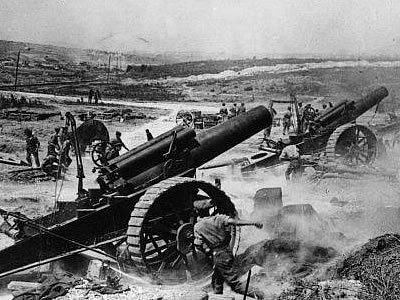
During the first half of 1916, the British had been preparing for the 'big push', which they hoped would win the war. At home the press reported a speech by a government official announcing that munitions factories had to work through the Spring bank holiday. The Germans knew that this meant an attack was coming, and they began practising retreating from their trenches into dug-outs construct ed 12 metres below ground.
Soon they had it down to just three minutes. At the front, German spy planes and balloons saw newly built roads and railways, and the arrival of fresh troops and huge quantities of ammunition and supplies. So, they were not surprised when British artillery began bombarding their trenches on 24 June.
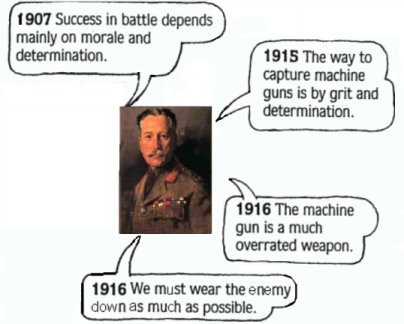
SOURCE 1
Some of Field Marshal Haig's statements about how wars should be fought. |
In December 1915 it was still stalemate on the Western Front. Neither side had made any real progress towards victory , although hundreds of attacks had been launched by either side and hundreds of thousands of soldiers killed. The British began to question how well their army was being led. and on 10 December 1915 a new commander of the British forces was appointed. He was Field Marshal Haig. He was 54 and he had already had a long and successful military career. In particular he had been a celebrated cavalry commander in the Boer War fifteen years earlier. In that war the British fought against a poorly equipped enemy on the dry plains of South Africa. Haig faced a difficult task. Trench warfare was a new kind of fighting. Some people had predicted years before the First World War that a European war would end in stalemate with each side dug into trenches. But no one really knew how to cope with trench warfare now it was here. No one knew how to win a war like this. So the generals fell back on the ideas they had used successfully in past wars.
British tactics
The British commanders believed that a constant shelling of German lines would knock out their trenches and destroy the barbed wire protecting them. So for almost a week, British guns across a line of 30 kilometres fired over a million and a half shells into German trenches. The British commander, Sir Douglas Haig, thought that there would not be 'even a rat' alive in the German trenches.
At 7.30 a.m. on 1 July, the bombardment stopped and the British and French soldiers began their attack along the 30 kilometre front. The British generals were so confident of victory that they ordered their men to cross No Man's Land at walking pace. There were, after all, no Germans left alive to worry about
The 'race for the parapet'
Unfortunately, however, when (the bombardment began, the Germans had begun sheltering in special reinforced dug-outs deep underground. When the shelling stopped, they knew that the Allies were coming and that they had to set up their machine guns on tlic trench parapet before the enemy arrived. But the Allies did not know (they were in a race and that they had to reach the German trenches before the machine guns were in place. The result was catastrophic to the British. German machine gunners found themselves facing waves of Allied infantry, walking across No Man's Land in the summer sun. The German guns cut down (the Allied soldiers in huge numbers. Only in a few places did British soldiers arrive at the German trenches in time to capture them. The first day of the 'great push ' saw the worst losses in British military history. But the disasters of the first day did not det er the Allies from continuing with the campaign.
SOURCE 2 The western Front in February 1916
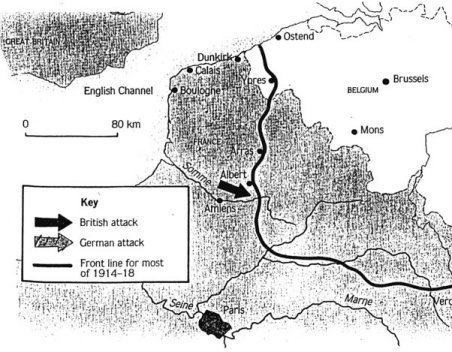
The attacks continued for the next four months, and September saw the first use of tanks in warfare. By November both sides were exhausted and the Allied attacks had ground to a halt in the dreadful clinging mud. In some areas they liad advanced 15 kilometres, but in others they had gained no land at all. Total casualties for the Somme campaign were British 420,000, French 200,000 and German 650,000.
British Losses on the first day of the battle of the Somme!
|
|
|
Killed/died of wounds |
|
|
Wounded |
|
|
Missing |
|
|
Taken Prisoner |
|
|
|
|
|
Total |
|
|
|